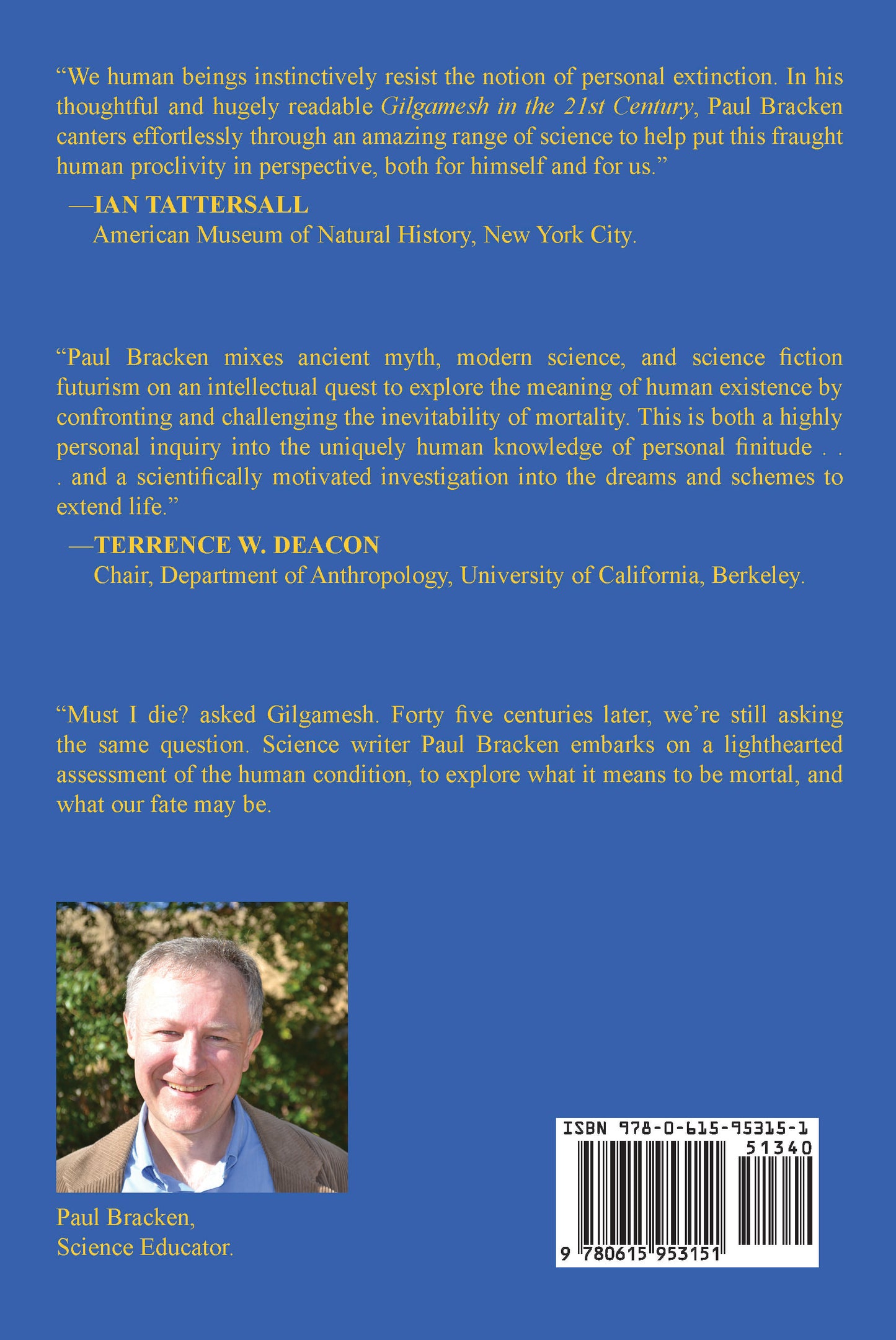
"Must I die?" asked Gilgamesh. Forty-five centuries later, we're still asking the same question.
In this scientific reimagining of the ancient Gilgamesh quest, science writer and Bracken Observatory founder Paul Bracken embarks on a lighthearted yet profound assessment of the human condition to explore what it means to be mortal, and what our ultimate fate may be.
The ancient Gilgamesh was so distraught at the death of his friend Enkidu that he rebelled against his fate and set out on a search for salvation. Likewise, at the age of eleven, Bracken wondered if there might be a way to bring his grandfather back from the dead—and has been pondering this question ever since. Is death a problem to be solved, or is it an essential aspect of our humanity?
This intellectual quest delves into a multitude of fascinating topics:
The origins of life and the relentless clockwork of biology.
The intricate workings of the human mind and human psychology.
The modern, scientifically motivated dreams and schemes for life prolongation.
Speculations on a future without human death, and how those immortals might view our current "Age of Death."
Advance Praise for Gilgamesh in the 21st Century:
"We human beings instinctively resist the notion of personal extinction. In his thoughtful and hugely readable Gilgamesh in the 21st Century, Paul Bracken canters effortlessly through an amazing range of science to help put this fraught human proclivity in perspective, both for himself and for us."
— IAN TATTERSALL, American Museum of Natural History, New York City
"Paul Bracken mixes ancient myth, modern science, and science fiction futurism on an intellectual quest to explore the meaning of human existence... In the end mortality stands unmoved, but we have a renewed appreciation of how this distinctly human knowledge and our ubiquitous antipathy to its inevitability have defined our humanity.”
— TERRENCE DEACON, Chair, Department of Anthropology, University of California, Berkeley
🔭 From the Desk of Paul Bracken:
"While we spend most of our time here at the observatory looking outward at the cosmos, writing this book back in 2013 was really about looking inward. It was a deeply personal journey, sparked by questions I’ve been asking since I was just a kid. How do we reconcile our drive to discover the Cosmos with our own finite timeline? One of the absolute greatest honors of my life was receiving a handwritten letter from Sir David Attenborough thanking me for his advance copy of this book! If you’ve ever looked up at the stars and pondered our place in the universe—and the fleeting nature of our time within it—I think you'll really enjoy this exploration."